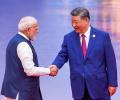
India's dual pursuit of a robust strategic partnership with Washington and a pragmatic, tension-management policy with Beijing represents the essence of modern multi-alignment. By embracing economic pragmatism, learning to compartmentalize political differences, and engaging in continuous dialogue, India can secure its borders, grow its economy, and contribute to a stable, multipolar Asian century, points out Ambassador Rajasekhar.

India on Friday reiterated that it follows a structured bilateral mechanism for the deportation of illegal Bangladeshi nationals and expressed hope that pending nationality verification requests with Dhaka would be expedited, amid fresh allegations by Bangladesh that the Border Security Force (BSF) was attempting to push people across the border.

Russian President Vladimir Putin has offered New Delhi Russia's fifth-generation stealth aircraft Sukhoi Su-57 and even suggested that the combat jet could even be jointly produced in India in line with the strong strategic partnership between the two countries.

The Indian embassy in Tehran has earlier stated that it is facilitating the safe movement of nationals who wish to leave Iran.

The India-Africa Forum Summit, scheduled for May 28-31 in New Delhi, has been postponed due to concerns over the Ebola virus outbreak in Africa. The Ministry of External Affairs announced that new dates will be finalised in consultation with African nations.

Tamil Nadu Chief Minister C Joseph Vijay has ordered the closure of 717 retail liquor outlets across the state, responding to public demand, particularly from women and political parties.

National Security Advisor Ajit Doval called for decisive action against terrorism and said there cannot be 'double standards' in the fight against it, while addressing an international security forum in Russia.

External Affairs Minister S Jaishankar and US Secretary of State Marco Rubio discussed cooperation in trade, critical minerals, nuclear energy, and defence, reaffirming commitment to a free and open Indo-Pacific.
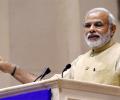
India has rejected allegations of human rights violations for the second time in three days, emphasising its constitutional values of justice, liberty, and freedom of expression. The remarks were made by Sibi George, Secretary (West) in the Ministry of External Affairs, in response to questions from a Norwegian journalist.

The US has announced federal charges against Nazeer Hameed, an Indian national, for his alleged involvement in the 2017 murder of Sasikala Narra and her six-year-old son Anish Narra in Maple Shade, New Jersey. Hameed fled to India after the murders and now faces charges for unlawful flight to avoid prosecution.

A 32-year-old Nigerian national died after being apprehended by Delhi Police during an operation. An investigation is underway to determine the circumstances surrounding his death.

The NEET-UG re-exam was held at centres across the country and overseas on Sunday amid tight security arrangements for the smooth conduct of the examination.

Following attacks in West Asia, hundreds of Indians, including prominent personalities, are stranded in Dubai and other key hub airports due to flight disruptions, prompting appeals for government assistance.

Funeral prayers were held for Bangladesh's former prime minister Khaleda Zia amid tight security. Millions joined the namaz-e-janaza of Zia, a three-time Prime Minister and political icon of Bangladesh.

The Delhi High Court has closed proceedings on Celina Jaitly's petition regarding her brother Vikrant Jaitly's detention in the UAE, directing the Centre to continue providing legal assistance.

A tanker carrying liquefied petroleum gas (LPG) for India has successfully navigated the Strait of Hormuz and is en route to Visakhapatnam, India, carrying enough cargo to meet half a day's requirement for the country.

A 26-year-old Indian man working in Riyadh has reportedly been killed in a suspected missile attack, according to his family. They are seeking official confirmation and assistance from the Indian government to repatriate his body.
A Delhi court has requested clarification from the Ministry of External Affairs regarding the extradition status of a former managing director of Bush Foods Overseas Pvt Ltd and his wife, who are residing in London, in connection with a money laundering case linked to an alleged Rs 750-crore bank loan fraud.

India has provided Afghanistan with 2.5 tons of medical supplies to assist those injured in a recent airstrike by Pakistan, which resulted in numerous casualties. This act underscores India's commitment to supporting the Afghan people during a difficult time.

India is closely monitoring the situation in West Asia and working to ensure the safety of its citizens stranded in the region. Over 52,000 Indians have returned home following the partial opening of airspace.

On the table are additional batches of S-400 surface-to-air missile systems from Russia, which India used with immense success during Operation Sindoor. India could buy at least two squadrons of Su-57 fighter jets plus joint production of S-500 air defence systems.

India has advised its nationals to avoid all non-essential travel to Venezuela following the capture of President Nicols Maduro by the US. The Ministry of External Affairs has also asked Indians in Venezuela to exercise extreme caution and restrict their movements.

India has firmly denied allegations that the US Navy is using its ports to launch attacks against Iran, reaffirming its commitment to strategic autonomy and non-alignment in international conflicts.

India strongly condemns Pakistan's airstrikes in Afghanistan, decrying the civilian casualties and reaffirming its support for Afghan sovereignty amidst rising tensions.
Families in Ambari village are anxiously awaiting news of their relatives stranded in Iran amid escalating conflict, with limited communication and growing concerns for their safety.

Gangster Sahil Chauhan, wanted in multiple cases and subject to an Interpol Red Notice, has been deported from Thailand to India. This marks the fifth deportation secured by Haryana Police this year as they crack down on organised crime.

Ukraine has lodged a formal protest with India regarding the detention of six Ukrainian nationals in Mizoram, alleging unauthorised entry and unlawful activities. The Ukrainian Foreign Ministry is seeking consular access and immediate release of its citizens.
Police in Meerut have confirmed that a woman found dead last month is a citizen of Turkmenistan, following initial misidentification. The investigation into her death continues, with several arrests made.

This could come as a setback to thousands of Indian engineers who have waited for years for their work visas to pave the way for the coveted Green Card.

To get its act going in Myanmar, India would need very dynamic diplomacy and not the lazy all-eggs-in-one-basket approach, points out Subir Bhaumik.

US Secretary of State Marco Rubio stated that significant progress has been made in negotiations with Iran to reopen the Strait of Hormuz, a critical global shipping lane. However, President Donald Trump remains cautious, vowing not to accept a 'bad deal' regarding Iran's nuclear programme and regional stability.

The US President had hosted Modi for an official working visit in Washington, DC, on February 13 last year.

Iran has blamed the US for disruptions in oil and gas shipping through the Strait of Hormuz, citing 'destabilising actions' as the cause amid the ongoing West Asia conflict and rising energy prices.

Border trade between India and China through the Lipulekh Pass in Uttarakhand's Pithoragarh district is set to resume this year after a six-year hiatus due to the COVID-19 pandemic.

The boundary mess between India and Nepal needs a solution in a manner as mentioned by Nepal's Foreign Minister Shishir Khanal: 'On evidence not emotions', counsels Lieutenant General Shakti Gurung (retd).
The family of a 26-year-old man from Uttar Pradesh, who was killed in a suspected missile attack in Riyadh, has demanded compensation and a government job for his widow from the local administration.

The BRICS foreign ministers' meeting in New Delhi concluded without a joint statement due to disagreements over the West Asia conflict, with Iran blaming the UAE for the lack of consensus. India, as the host, issued a chair's statement highlighting the differing views.

The Cabinet Committee on Security (CCS) has reviewed the evolving situation in West Asia, directing departments to assist Indian nationals affected by recent developments and emphasizing the need for dialogue and diplomacy.

External Affairs Minister S Jaishankar on Tuesday said India is concerned about the recent developments in Venezuela, marking the first strong public statement after the latest United States actions in the South American country.

Onestruction Inc and DataKaveri Systems have signed an MoU to establish a framework for strategic and technical collaboration in urban and built environment data exchange.
